
EMA Regulatory Counsel Contacts: Jeff Leiter and Jorge Roman
Pursuant Section 312 of the Emergency Preparedness and Community Right-to-Know Act (EPCRA), Tier II chemical inventory reports for calendar year 2025 must be filed with the State Emergency Response Commission (SERC), Local Emergency Planning Committee (LEPC) and local fire department by March 1, 2026.
Since 1987, EPCRA requires covered facilities, including those operated by energy marketers, to report each year on chemicals, including petroleum products, present at the facilities during the previous calendar year in quantities equal to or greater than established threshold quantities (discussed below). The information contained in the Tier II reports is used by state and local governments to respond to emergencies and address risks associated with stored hazardous chemicals.
Minimum Threshold Reporting Trigger
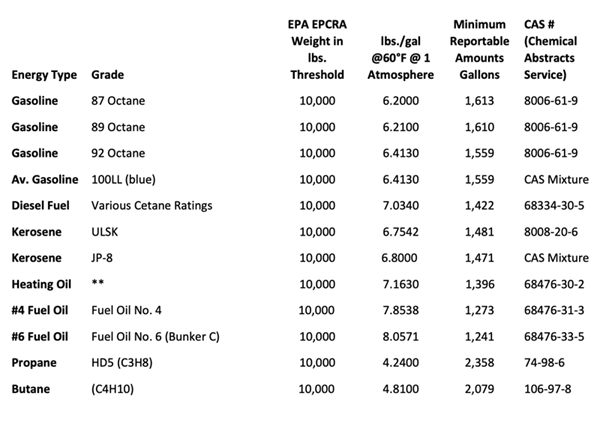
General Rule –– Covered chemicals are those chemicals for which Safety Data Sheets (SDS) are required under OSHA’s Hazard Communication Standard (29 CFR §1910.1200). Accordingly, facilities that store more than 10,000 pounds of a hazardous chemical at any point during the previous calendar year must file an EPCRA Tier II report. The 10,000 pounds compliance threshold is calculated by aggregating the maximum quantity of the hazardous chemical present onsite across all storage containers, including aboveground and underground storage tanks and portable skid tanks.
-
Note: Under the regulation, the actual quantity stored is the trigger, not the storage capacity.
-
Note: The household product exemption does not apply to heating oil stored for distribution or used for heating in business buildings.
Retail Fuel Threshold –– Retail gasoline facilities with 75,000 gallons or less of underground gasoline storage capacity and 100,000 gallons or less of underground diesel fuel storage capacity are exempt from EPCRA Tier II reporting requirements, provided that the underground storage tanks were in full compliance with Federal or State UST regulations at all times during the previous year. Cardlock fueling facilities are also subject to the retail fueling facilities exception, with the same storage capacity limits above.
The following gallons-to-pounds conversion chart below can be used to determine the 10,000-pound reporting trigger applicable to storage facilities other than retail gasoline and diesel fuel stations:
Information Required
EPCRA Tier II forms require information on the “physical hazards” and “health hazards” of each product stored on site where the minimum reporting threshold is triggered. EPA has adopted the physical and health hazards from OSHA’s HCS. Physical hazards and health hazards information, as well as the applicable Chemical Abstract Service (CAS) numbers, are obtained from the product’s Safety Data Sheet (SDS). Suppliers are required to provide a copy of the most recent SDS for each product sold to downstream energy marketers. Suppliers often post SDS for their products on their websites as well.
The physical and health hazards categories appear as two separate columns on the EPCRA Tier II Form. Under each column, a series of hazards are listed next to check off boxes. Petroleum products including gasoline, diesel fuel, heating oil, kerosene, etc. generally share common physical hazards and health hazards. Check off the following boxes under each column on the lower half of the form used for reporting “mixture or Product Name” (check corresponding product SDS for any variation):
-
Under the physical hazard column on Tier II form, check off the boxes marked “explosive” and “flammable”
-
Under the health hazard column on Tier II form, check off the boxes marked “skin corrosion or irritation,” “serious eye damage or irritation,” “respiratory or skin sensitization,” “carcinogenicity,” “reproduction toxicity,” and “aspiration hazard.”
-
For propane, check all the boxes above plus “simple asphyxiant” and “gas under pressure.”
NAICS Codes & D-U-N-S Identifiers
North American Industrial Classification System (NAICS) codes must be used on EPCRA Tier II reports. Applicable NAICS codes for the petroleum marketing industry include:
-
Petroleum Bulk plants - NAICS 424710
-
Retail Gasoline Stations with Convenience Stores - NAICS 447110
-
Retail Gasoline Stations without Convenience Stores - NAICS 447190
-
Cardlock Sites – NAICS 447190
-
Heating Oil Dealers - NAICS 454310
-
Propane Dealers – NAICS 454310
Facilities must also enter their Dun & Bradstreet (D-U-N-S) number. This identifier helps state and local authorities identify facilities submitting Tier II reports. To find your D-U-N-S number go to: My Dun and Bradstreet Number.
Filing Forms & Authorities
-
Paper Forms - EPCRA Tier II forms and instructions for paper filing may be downloaded here.
-
Electronic Forms - Most states require EPCRA reports to be filed electronically through the EPA’s Tier II filing portal. The Tier II electronic filing portal for Windows and Mac applications may be downloaded here. An electronic filing tutorial is also available in that link.
Most states follow the reporting procedures described above. However, some states may vary. A complete list of state EPCRA Tier II requirements and where to file can be downloaded here.
Fees and Penalties
The fees associated with Tier II reporting vary by state, as each state sets its own fee structure for the submission of these reports. At the Federal level, there are no fees imposed for submitting a Tier II form. Consult state requirements here.
The EPA civil and administrative penalties for violating EPCRA Tier II reporting range from $23,331 to $174,985 per day, per violation. These civil penalties are subject to inflation adjustment each year. EPA checks for filing of EPCRA Tier II reports during routine compliance audits or after a release.